Friday, July 31, 2009

Lift Every Voice and Sing


This Sunday is our summer hymn sing, a great opportunity to celebrate some of our favorite hymns and lift our voices in prayer and praise. Be sure to sing loud and strong! These are hymns everyone will know, after all, and there are few things in life more inspiring than the confident melding of voices on the great hymns of faith.

You'll be hearing a bit of history and information about each hymn on Sunday, so I won't take the time or space now for that background on each hymn. I do, however, want to draw your attention to the variety of moods and expression that our hymnal covers. We will begin with "Gather Us In," a modern tune that sums up the fellowship of corporate worship.

We will continue with the bombastic "Crown Him with Many Crowns," which will contrast with the reverent prayer of "Beautiful Savior." The mood will be lighter (and the kids will hopefully join in loudly as well) when we sing "What a Friend We Have in Jesus." The service will close with two rousing hymns of faith and evangelism: "Onward Christian Soldiers" and "Lift Every Voice and Sing."

Last Sunday, Pastor Uhle reminded us of two topics related to those last two hymns. First, it is important that churches remain growing, thriving hubs of spiritual activity and fellowship. For some people, that means volunteering with the building committee work days or altar guild. For others, it means quilters or Young at Heart activities. Of course, the church is full of volunteers and leaders, but we always welcome more. As a musician, I'd be most thrilled to see more people in the choir or playing instruments or simply providing input for the music program. Ask yourself if you can be more active as a "Christian Soldier" or if there are more ways you can contribute your voice to the congregation.

Second, Pastor Uhle reminded us that the ELCA's Churchwide Assembly in Minneapolis is less than three weeks away. Among the topics that body will consider are full communion with the United Methodist Church, the rostering of gay and lesbian ministers, and a statement on human sexuality. All three matters are votes of inclusion, collaboration, and fellowship. My prayer during "Lift Every Voice and Sing" will be that the ELCA continues to move toward a future where truly every voice is welcomed and valued.

I won't quote the text of that hymn here, since you can read it on Sunday, but instead I'll share some lyrics from the Broadway musical Ragtime, with a similar sentiment set to a soaring tune at the end of the show:

Go out and tell the story.
Let it echo far and wide.
Make them hear you...

My path may lead to heaven or hell
And God will say what's best
But one thing he will never say
Is that I went quietly to my rest...

Proclaim it from your pulpit,
In your classroom, with your pen.
Teach every child to raise his voice
And then, my brothers, then

Will justice be demanded
By ten million righteous men.
Make them hear you...

Wednesday, July 29, 2009

Pastor Uhle's rhetorical flourish

Since I've been ranting about language this week, one phrase from Sunday's sermon has stuck with me. Pastor Uhle delivered this nicely crafted phrase:

"God dwells in people, but those same people dwell in buildings: churches."

I love the balance of the line. The chiasmic nature of its structure, the repetition of "people" and "dwell," and the emphasis on the word churches caused by the delayed contrast with more mundane "buildings." I wonder if it was written or extemporaneous or a mix. In any case, it's fantastic oratory.

This is the kind of language that leaves me inspired for the week. His message that a church is more than a building resonates strongly in a period of church closings around us. Our church is comprised of people and language and music, but also a Sunday school and a web site and a blog and a choir and committees... The church is a mosaic of many things, all of them need inspiration and participation to survive. In other words, join the choir this fall!

Tuesday, July 28, 2009

Rhetoric

Again, language is on my mind this week. As I thought about yesterday's post I realized how many people automatically precede the word "rhetoric" with the word "empty." We've all adopted the stance of the anti-hero Holden Caulfield in labelling everyone a phony, in assuming that the formal is dressed up because it has no substance.

Au contraire! Rhetoric is the art of language. Combined with grammar and logic, it forms the linguistic triumvirate of human discourse. The best hymns are based on the best poetry, and language has driven the development and understanding of religion throughout all time. For instance, Martin Luther's theses were written in the formal style of the time. The dialogues of Thomas Aquinas are practically transcribed conversations in an eloquent flourish of the Latin language.

Of course, the psalms are the best example we have of poetic language and music in the church. Consider the 23rd psalm. This web site provides five different translations of the famous text. The King James is poetry, the text that causes us to straighten our back and lift our chin. The Contemporary English Version, on the other hand, is a casual address to a Buddy Christ-type conception of God. I find it particularly interesting that the RSV and NRSV held on to the word "shall" in the first verse. They instinctively knew that for such a famous verse, people would demand the more formal language.

Why do I think it's important to hold on to both formal English (and even some Latin) in church? Because it's beautiful, it's memorable, and it demands our attention and intention during the service. Aren't those among the goals of worship?

Monday, July 27, 2009

Language in church

I've been thinking a lot about language recently. That's mostly because I've been reading a book by one of my favorite linguists John McWhorter, titled Doing Our Own Thing: The Degradation of Language and Music and Why We Should, Like, Care. His premise, in a nutshell, is that the cultural change of the 1960s caused us to abandon our love for formal English, both written and spoken. We've replaced it with a constant search for the lowest common denominator (newspapers writing with middle school vocabularies), "authenticity" (a freedom to use casual speech and even expletives liberally in music and speech), and the common notion that great orators and the days of elocution are firmly behind us, no longer necessary. Sunday's prayers and hymns are a perfect illustration of this formal/informal divide between the generations, the difference between loving language and communicating in the vernacular.

Because of the 80th anniversary, we used hymns and prayers that have been around for many years, drawn from older hymnals of the church. This led to quite a sprinkling of "thee" and "though" and "most heartily beseeching." The prayers ended with an address to Christ, "who liveth and reigneth with thee." I'm sure there were people who asked themselves who would ever talk like that.

That opinion is perfectly natural for the zeitgeist of today, but no one would have considered such language inappropriate in 1929. That isn't because people spoke that way at all times. Certainly F. Scott Fitzgerald did not woo Zelda by saying, "I heartily beseech thee to accompany me to the speakeasy." The language was out of fashion even then; just see films of the era for proof. However, when people went to church they dressed in their Sunday best and expected to hear eloquent language and oration. People knew that there was a way of speaking in church (and other formal situations) that differed from casual conversation. One modern holdover is a wedding invitations or announcements, where the formal aspects of language still occur more regularly than in, for example, a birthday e-vite.

As for the hymns, some of the hymnals best and most cherished hymns still use a formal, more eloquent language. For example, who would want to tamper with ELW 685 "Take My Life, That I May Be"?
Take my life that I may be
consecrated Lord to Thee;
take my moments and my days;
let them flow in ceaseless praise.

It's basically a trochaic quatrain: four rhyming lines of lilting syllables. Read it aloud, and it might sound like this:
TAKE my LIFE that I may BE
CONseCRAted LORD to THEE

That's formal poetry. That's a lyricist crafting formal language in a beautiful hymn, language that strives for excellence and yearns for inspiration from heaven. That's language and music worth singing!

PS Thanks to Mary Frances for her beautiful singing on Sunday, and also thank you to everyone for your birthday wishes.

Sunday, July 26, 2009

Unorthodox Wisdom, Part 8: Television

Last week, I listened to Public Radio's "Speaking of Faith" (a show that may have come up a time or two before!) and their discussion about television. In recent years, with the advent of high quality cable drams, television has been awash in writing and acting of extremely high caliber. And many of the shows have not shied away from spiritual musings. To give just one example, Damon Lindelof, co-creator of Lost, offered this explanation for the show:

This show is about people who are metaphorically lost in their lives, who get on an airplane, and crash on an island, and become physically lost on planet Earth. And once they are able to metaphorically find themselves in their lives again, they will be able to physically find themselves in the world again. When you look at the entire show, that's what it will look like. That's what it's always been about.

Krista Tippett mused that the metaphor of going home suffuses the human experience. It's the theme not just of modern television but of the Odyssey and the Exodus. I would add Watership Down and The Razor's Edge to that list. One of the great themes of literature and worship is the idea of returning home. Having played organ for a funeral at Bethany last week, I'm acutely aware of how many of our best known hymns are also about our eternal home and rest.

The theme of going home does not always lend itself to hymn texts that are theologically profound enough for inclusion in the ELW and the traditional Lutheran canon. But I'll close today with a somewhat popular hymn on the theme that you may be familiar with. It is sung to the tune of the second movement of Dvorak's New World Symphony:

Going home, going home,
I'm just going home.
Quiet-like, slip away -
I'll be going home.
It's not far, just close by;
Jesus is the door;
Work all done, laid aside,
Fear and grief no more.
Friends are there, waiting now.
He is waiting too.
See His smile! See His hand!
He will lead me through.

Friday, July 24, 2009

This Sunday, turning 80

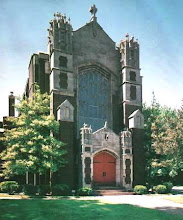
This Sunday, Bethany will be commemorating its 80th anniversary at the Triskett location. As pastor has noted, this is not the official anniversary of the complete building's dedication, but rather the anniversary of the first service held at the site. In 1929, this summer service was held in the basement because the sanctuary itself was not yet completed.

Unfortunately, the music from that first service is not known to us. We do, however, have a copy of the bulletins from November of that year, when the building was dedicated. Therefore, all of the service music will come from pieces that were played that week, nearly 80 years ago.

The prelude will be selections from "Suite Gothique" by Leon Boellmann. He was a Frenchman who was born in the German-border region of Alsace. He was a younger contemporary of the better known Franck and Saint-Saens, and the music has a distinctively modern, French sound. Because he died at the young age of 35, he did not leave a large body of music and his name is not well known. "Suite Gothique" is likely his best known piece and some would consider it a staple of the organ repertoire. I will be playing the Chorale Introduction and the Prayer to Notre Dame from the suite.

Looking back over the 80 year history of Bethany, it's interesting to see what music has come and gone, as well as what has remained the same. The broader perspective of history so often dwarfs the parochial arguments that fill our lives (and committee meetings). Incidentally, both of my grandmothers turn 80 this fall, both of them born in October, just after the stock market crash. When I was home in Minnesota, one of them told us stories from her childhood about birthdays and Christmases where an orange was both a gift and a rare treat and about the blackout drills of World War II. Such personal histories can also inspire us to strive for greatness in these difficult times and to be thankful for the gifts we have.

To go back even further in history, some of the greatest Lutheran hymns of faith were composed in the time leading up to and during the Thirty Years War, including the text "In Thee is gladness, amid all sadness, Jesus, sunshine of my heart." I've remarked before that the first book published in America (during a time of self-evident hard work, disease, and challenge) was a hymnal.

Let's celebrate 80 years of wonderful history while also dreaming and planning, reaching out to the congregation and community for many more years to come.

Thursday, July 23, 2009

"This is Water"

One of the most brilliant American authors in recent years was David Foster Wallace. My personal favorite is his nonfiction Everything and More about the mathematical history and philosophy of infinity. He took his own life in 2008, and this spring a graduation speech of his was issued posthumously, titled This is Water: Some thoughts, delivered on a significant occasion, about living a compassioante life.

To an astute reader, the book is a modern rewriting of the book of Ecclesiastes. Midway through, Foster Wallace writes, "In the day-to-day trenches of adult life, there is actually no such thing as atheism. There is no such thing as not worshipping. Everybody worship. The only choice we get is what to worship." He goes on to examine the various idols of modern life: money, the human body, power, and intellect. He concludes about each that they are inadequate for worship, like Ecclesiastes chasing the wind.

The conclusion goes further, however, by positing that the main reason these worships are poor choices is that they are default settings. He argues that people mindlessly make the big decisions of life to focus on the minute freedoms of daily life. He writes, "The really important kind of freedom involves attention, and awareness, and discipline, and effort..."

The real freedom of church and worship and music is to focus our attention, to sing and pray and meditate mindfully. Like the title metaphor, those of us who attend church regularly can be surrounded by hymns and liturgy and miss their vitality and meaning without careful, thoughtful attention.

Incidentally, since the book is a graduation speech, it can be read in less than 30 minutes. Pick it up from the library, if you're interested.