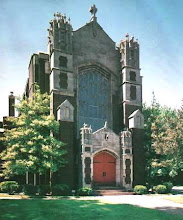
Welcome to Advent and the start of a new church year. This past Sunday was a refreshing change of pace in so many ways. For one thing, the altar guild had hung banners, put out the Advent wreath, and changed the altar colors to blue. I also noticed the stark contrast between Wednesday night's service when all the windows were dark. The silence of an evening service always seems heavier and more contemplative. By contrast, this past Sunday the light through the stained glass seemed especially brilliant.
We also switched our liturgical setting. We've returned to ELW setting 3, which is familiar to us from the LBW. This is honestly the first time since the ELW was introduced that I didn't feel a sense of relief upon returning to the familiar music. I had become used to the sound of the upbeat music of setting 2, and the "new" setting seemed almost pedestrian by comparison. I still love the music, but it no longer provides quite the same sensation of returning home. Do other people feel the same way?
The choir had the week off, but they'll be hard at work with Christmas preparations. It's so appropriate that Advent is the season of preparation and anticipation. A musician can never forget that! Everyone is busy with preparations - whether decorating, cleaning, making travel plans, or just trying to finish the school semester and holiday season still in possession of your sanity. Of course, none of those are as important as the spiritual preparations we come together to sing about every Sunday at the beginning of this new year.
Tuesday, December 1, 2009

Sunday, November 29, 2009
Unorthodox Wisdom - Buffy and Victor Hugo
Empathy and love of neighbor is at the heart of Christianity and also a theme of some great music and literature - To Kill a Mockingbird is the classic example. But I was thinking of it this week when I watched an old rerun of "Buffy, the Vampire Slayer."
The mere mention of that show (or any work by Joss Whedon) is sure to inspire nods of recognition of his genius from rabid fans, looks of derision from the uninitiated, and shrugs from the majority of the population. You can guess my bias in that continuum, but the show is a great guilty pleasure of mythology and philosophy in a story that turned the traditional vampire plot on its head. The young blonde girl doesn't twist an ankle and get eaten; she's the strong heroine of the story.
At any rate, in this particular episode, Buffy prevents a classmate from committing suicide. He is depressed because he feels invisible and lonely, ignored by the popular students, and burdened by personal pain that no one notices. Rather than offer the typical platitudes and comfort, however, Buffy responds with this monologue:
"I was wrong. You are an idiot. My life happens to, on occasion, suck beyond the telling of it. Sometimes more than I can handle. And it's not just mine. Every single person down there is ignoring your pain because they're too busy with their own...If you could hear what they were feeling, the loneliness, the confusion. It looks quiet down there. It's not. It's deafening."
Her speech reminded me of a scene in Victor Hugo's novel commonly known as "The Hunchback of Notre Dame." The priest's brother observes him in a moment of extreme emotion, and Hugo depicts his reaction:
"...he knew not with what fury that sea of the human passions ferments and boils when it is refused all egress; how it gathers strength, swells, and overflows; how it wears away the heart; how it breaks forth in inward sobs and stifled convulsions...The merry scholar never dreamed of the boiling, furious, and deep lava beneath the snowy brow of Etna."
Music can express and expose those emtions within us. As a congregation and as Christians, we are obliged to open our ears and our eyes to those around us, in their joy and in their suffering. When we sing a hymn, think of our voices blending; listen to each other; notice how our shared music erases the divisions among us.
Tuesday, November 24, 2009
Join us for Thanksgiving worship

Didn't it feel great to have a full church this past Sunday? By having only one service to accomodate the budget meeting, we really packed the pews. That created an energy and vitality in all aspects of the service, and I especially loved to hear the congregation singing with gusto, even on a relatively unfamiliar hymn.
I invite you all to help us fill the church again: tomorrow is our Thanksgiving Eve worship service at 7:00. We have some fantastic music planned, including guest trumpet players and a flashy arrangement of "Now Thank We All Our God" that I hope you'll love to sing.
The choir's anthem will be "Stay With Us" by Egil Hovland. It's a beautiful composition with lush chords and harmonies. The middle section with four-part women's harmonies is sung particularly well by our small group. I hope our congregation realizes that we are blessed to have such strong dedication from our choir (and we're always happy to welcome other to join us, of course!). The text of the anthem is based on the last chapter of Luke's Gospel, when Christ appears on the road to Emmaus and interprets the scriptures for his disciples. The text comes from the moment when Christ appears to be leaving, and they urge "Lord, stay with us, because it is almost evening and the day is now nearly over."
They proceed to eat dinner together, with Jesus blessing the meal. It's a quiet moment in the Gospel story, gathering together to give thanks and to comfort each other. The modern Thanksgiving tradition does similarly tend to be about coming together with family and friends (in contrast with the secural corruption of Christmas). However, don't forget that the true origin of the holiday is a day of prayer and thanks for the many blessings in our lives. Surely, we can take time out from cooking and cleaning to come to church for worship and fellowship!
Sunday, November 22, 2009
Unorthodox wisdom - Marvin Hamlisch
Not too long ago, I listened to an interview on public radio's "Studio 360" with Marvin Hamlisch. He was talking primarily about composing the music for various films, including his most recent work for "The Informant." It was interesting to hear him describe the process of thinking about a character and having a musical motif simply come to mind. The host went so far as to describe it as a kind of synesthesia.
I don't think of myself as a composer, though I dabble in small things for church. But I think the truly great composers think primarily in a musical language that is their mother tongue, in the way Hamlisch is describing. They hear text and immediately translate it into music; they feel an emotion and hear a melody.
Church music is elevated prayer, whether or not it includes text. At its best, it is the sublime expression of praise and penitence, prayer and proclamation. Of course, Hamlisch composed music for "A Chorus Line," which encapsulates this process in the medium of dance. In particular, the song "Music and the Mirror" talks about expression through dance. I'll close with a portion of that song's lyrics today:
Give me somebody to dance with.
Give me a place to fit in.
Help me return to the world of the living
By showing me how to begin.
Play me the music.
Give me a chance to come through.
All I ever needed was the music, and the mirror,
And the chance to dance for you.
Friday, November 20, 2009
Chancel Choir sings gospel

This week, the choir will be singing a popular gospel song titled "He Never Failed Me Yet." It'll be a big change of pace for us and an important part of hearing a variety of musical styles. We've been having a lot of fun singing it in rehearsals.
Beyond the musical style, though, gospel and spiritual traditions contrast with traditional Lutheran music in their text as well. Usually, the text is built around a repetitive chorus that allows for musical improvisation and a focused spiritual message.
In his book Church Music, Edmund Lorenz describes the style as "A sacred folk song, free in form, emotional in character, devout in attitude, evangelistic in purpose and spirit... These hymns are more or less subjective in their matter and develop a single thought rather than a line of thought."
We've enjoyed rehearsing the piece, and Lisa does a great job improvising the lead vocal part. I think you'll enjoy the anthem, and I hope it has you inspired to tap your feet and maybe even clap along with us!
Wednesday, November 18, 2009
We, like sheep
Last Sunday, we had a guest pastor, which is always a harrowing experience for all concerned. Every church, like every family, has its idiosyncratic practices. When those are violated, it can create a brief moment of discomfort, but it can also call us to greater participation and leadership, refreshing our worship experience.
I'm thinking of one specific moment during the service, following the offering, when we are used to a certain way of presenting the offering on the altar and a particular offering prayer. Pastor then turns to face the congregation and makes eye contact with me at the organ so that I know we can being the Great Thanksgiving. Without our usual practices, the acolytes didn't know what to do with the offering plates, I didn't know when to begin the music, and the service faltered for just a brief moment. Of course, it was a minor issue, and the service continued.
From a musical perspective, it made me think of two things. First, the rhythm and melody of the liturgy and the hymns can truly unite a congregation, even if the prayers are offered with a slightly different verbal stress or the service is not one hundred percent aligned with our past experience. When I travel and attend services, there is a sense of being an observer, until the music begins. When a congregation is singing, we are all together in one endeavor.
Second, we (like sheep) do go astray when we don't have strong leadership. Once, a choir director of mine asked the group who was the leader of our music. Most people said the director, some said the accompanist, some pointed to section leaders or particularly strong singers in the group. But the director said all those answers were wrong. Every single member of the choir needed to be a leader for it to work. If you wait for the person next to you to sing, then you are already late, of course. The best choirs have a confidence and shared trust among themselves because they are all leaders.
Perhaps the experience of having a guest pastor can shake us up a bit and encourage us all to step up and take responsibility and leadership. A congregation is a community, and it thrives on participation, in its ministries and its music.
Sunday, November 15, 2009
Unorthodox Wisdom - Peter Vaill
Next week we have our congregational budget meeting. Like all mission-driven organizations, churches struggle to balance priorities, mission, and budget. Of course, the struggles of Catholic churches around the Cleveland area have been prominent in the headlines, and no congregation seems to be immune from the demographic and economic challenges around us.
The biggest danger is to think that we will restore all our priorities "when things calm down" or "get back to normal." When you prepare music every week, you quickly learn that things never do settle down into the free time you'd like to have to accomplish all your goals. You simply do the best you can, ask for help, and try to look at the big picture as much as possible.
It all reminds me of the business management writings of Peter Vaill. One of his books is titled Permanent Whitewater, and the premise is that the business world is always in flux. You must make decisions in times of turmoil and hope for the best. I'm hopeful that we will make prayerful decisions, keeping in mind our mission and planning for the future.
Subscribe to:
Posts (Atom)