Friday, January 29, 2010

Open Now Thy Gates of Beauty


The opening hymn this weekend is providing the inspiration for much of the service music. I was rereading the text of the hymn "Open Now Thy Gates of Beauty," confident in my memory of a simple and straightforward hymn, just a joyous gathering tune and text. And that certainly is the overall mood of the hymn.

The middle of the first verse, however, caught my attention with these words, "...where my soul in joyful duty waits for God who answers prayer." The concept of "joyful duty" doesn't pervade the zeitgeist of modern America. Our psyches and daily actions are more geared toward "the pursuit of happiness." But it has long been my belief that the Christian faith is, at its heart, about joy in all things, even foreign ideas to us like "duty."

Suddenly the hymn took on more depth as I continued my reading. The final verse begins, "Speak, O God, and I will hear thee, let thy will be done indeed." Coming together at worship on Sunday is about duty and joy, praise and service, and all those ideas should be ever-present in our prayers.

Both the meditative prelude and the postlude will be arrangements of this hymn tune, the former by Jan Bender and the latter by Paul Manz, both well-known modern organ composers. I hope the music helps you hear the tune in a new way and that you pay special attention to the text when we sing it so that the music helps guide your prayer and worship.

Wednesday, January 27, 2010

In praise of church music

I came across this quote from the Catechism of the Catholic Church, and I thought it would be perfect to share here:

"The musical tradition of the universal Church is a treasure of inestimable value, greater even than that of any other art. The main reason for this pre-eminence is that, as a combination of sacred music and words, it forms a necessary or integral part of solemn liturgy."

To put the same idea in my own vernacular version, I'd paraphrase the musical "Nine": What good is church without le singing? (And that idea is even more fun if you can hear Judi Dench singing it in your head.)

So is it true that music is greater than any other art when it comes to religious value? Can we even measure the value of Michelangelo's Pieta against Mozart's Requiem? Or perhaps the value simply in the weekly direct participation of the congregation in music.

Tuesday, January 26, 2010

Understanding Bach

One of the comments from last week's Bach debate was basically that his music is too difficult. Not everyone can hear what's going on in his complicated fugues. The hymn tune can get lost in ornamentation, and it's generally a new sound for most people.

I'd like to draw an analogy to visual art in our churches. There are church traditions that have vehemently rejected all forms of idols, icons, and representation, largely the American Puritans and their spiritual descendents, along with the Mormon church. The difference between a Methodist or UCC church is visually obvious, when compared to the more "symbolically oriented" churches, the Orthodox, Catholic, and (to some extent) Lutheran churches.

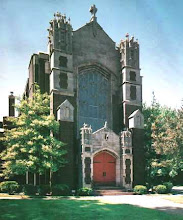
I've had debates with people who say that all artistic representations, even the stained glass windows at Bethany, are inappropriate idolatry. Now, I won't dispute the fact that some of the churches I have mentioned do venerate relics and idols to a questionable degree, but I'd like to offer a different point of view. The great cathedrals of Europe were built at a time when the masses were illiterate, and the art and architecture of a church were meant to help explain the Biblical stories symbolically. The scenes depicted in our windows are similarly there as reminders to guide our prayer. We may not notice them every week. We may not ever examine them closely, but if at any time you choose to take a closer look, you will find that they point you toward the Bible.

Similarly, the great classical music (and in particular much of the music of Bach) is another way to point toward the stories, the text, the Bible. It's a very Lutheran concept to use music and the visual arts to point toward Scripture. We may not always hear every detail or "understand" every aspect of the music, but it is worthy music that holds up to scrutiny at many levels. It's pleasant to hear, and it enlightens and enlivens prayer and meditation.

Do you have a favorite example of music or art aiding your spiritual journey? For members of Bethany, when did you last notice the windows - any favorites? I hope this blog is helping people connect more directly with the music you hear each week so that you're always able to continue growing both musically and spiritually.

Sunday, January 24, 2010

The classical-country divide

My entry about Bach last week drew a few comments that might be called evidence of a cultural divide. To be very broad, I'd suggest that most people fall into one of three classifications: There are people who love classical music and look down on country music. There are people who love country music and dismiss classical music as elitist. And there are people who are eclectic and love a variety of music, including some classical and some country. Of course, country and classical are chosen here simply as examplars from two broader categories (plus they have a nice alliterative quality, don't you think?).

Reality or talent shows sometimes play on this division. The finale of the most recent season of "America's Got Talent" featured an opera singer and a country singer. I didn't hear either of them sing, but I predicted the winner. Always bet on country music in a popularity contest!

Of course, there is beauty in simple melodies, folk music, gospel, jazz, country, bluegrass. Most of the American innovations in music have bubbled up from the people as popular expressions of music, rather than the European tradition of court music. We do want to include that sound in church. One difficulty from my point of view is that it often isn't appropriate for congregational singing or isn't written with a text that lines up with Lutheran theology. And so, as members of my congregation know, I play a variety of music but the majority stems from classical sources, and much of our hymnal reflects centuries of European musicians. I don't think I've played any Amy Grant. Since her music came up in the comments last week, I'll have to search out something as an offertory or communion piece, perhaps. Any other suggestions? Music you miss or music you'd love to hear? You can always share online or in person!

But keep in mind that maybe it's not a bad thing that church music is often different from what we hear in our daily lives. It helps create a sense of the sacred. We'll keep inviting in new sounds and aim for variety, and I'll have more to say on the debate tomorrow. But to close today, a simple country tune that I sang along with to a commercial the other day (much to the amazement of my significant other). Sing along!

Stick shifts and safety belts,
Bucket seats have all got to go.
When I'm riding in my car,
It makes my baby feel so far...

And God bless Lynne Rossetto Kasper at MN Public Radio for putting that hummable, memorable tune in my mind most weeks!

Thursday, January 21, 2010

A royal march, et al.


I thought I'd start my entry on this week's music by proceeding backward from the postlude. I'll be playing "Festive Voluntry" by Henry Purcell, who is a 17th century British composer. Purcell is not known as a church composer; he was principally a court musician and composed music for the royal family. Because of that, he's known mostly for marches and voluntaries.

It's precisely the non-sacred source of the music that made me stop to think this week. Why do we (meaning church organists, principally) still play non-sacred classical music like this for a postlude? It can be difficult to justify in some situations. My answer would be threefold: 1. it's good music that has stood the test of time; 2. not a lot of people are paying much attention to a postlude anyway; 3. royal marches symbolize Christ as king. Do you agree with those reasons? Do you have more of your own to add?

There's no such sense of unease about this week's prelude, which is a fugue by Walcha on the tune "Wie schon leuchtet der Morgenstern." The most common text to this tune is "O Morning Star How Fair and Bright." This particular arrangement doesn't literally spell out the whole tune, but you can hear snatches of the well-known tune among each of the three voices in the fugue. Listen carefully for how Walcha has updated and added to the tune, or hum along when you hear familiar snippets.

Wednesday, January 20, 2010

Even genius millionaires used to sing and dance


During my time in Florida, we visited the winter home and laboratory of Thomas Edison and his next door neighbor Henry Ford. It's a beautiful estate, of course, and the variety of plants is amazing, particularly the huge banyan tree that no visitor there ever forgets. (That tree was among the things that had stuck with me from an earlier visit years ago.)

On my tour this time, however, I especially noticed our tour guide's comments about the important roles of music and dance in Edison's life. Edison enjoyed playing the piano in his spare time, and he met his second wife at a party when she played a piece by Chopin that caught his attention. His grand piano is still on display at the house.

The guide also told stories about parties at the estate, when the carpets would be rolled up so that the people could square dance. Edison and Ford apparently both loved to square dance, and it was a requirement for their employees to know how to dance.

Ironically, Edison's own inventions have distanced us today from such active participation in our own entertainment, both music and dance. Musical recordings and movies and television (not all direct Edison inventions, I realize, but certainly all stemming from his work) create unrealistically perfect performances and encourage our passive, private enjoyment of the arts. I doubt that parties at Bill Gate's home still involve rolling up the carpets to square dance. A societal shift away from participation in the arts is a great loss for all of us. It's important for our spiritual health to maintain our connection with the arts, and church is one venue where we can still sing with family and friends. Where else in your life do you still sing (or dance)? That's just one more reason to sing with gusto this Sunday!

Monday, January 18, 2010

A paean to Bach

During my holiday break, I finally started to catch up on reading the pile of books that had accumulated on my bedside table. Among them was the excellent novel Life After Genius by M. Ann Jacoby. One of my favorite passages is the narrator's praise of Bach's music:

"...when the music fills the air, it is as if God himself has entered the concert hall. Forget all those sermons the ministers used to go on at length about week after week, trying to hammer the word of God and make it stick. If there is a God, this is how he communicates. Through music. And if there is a vehicle through which God speaks best, it is Johann Sebastian Bach."

In the past 250 years of enjoying Bach's music, many people have agreed that his genius communicates the essence of our faith. But I also had the time on my break to rediscover the joy of a variety of music on my ipod. Many composers and styles speak to us, and sometimes the most powerful and memorable music simply depends on our mood and state of mind. What composers, hymns, and songs speak most directly to you?